
About the Client: Ascanius
Ascanius: The Youth Classics Institute is a nonprofit organization dedicated to advancing knowledge of Latin, Greek, and the ancient Greco-Roman world, especially among elementary- and middle-school students.
Since its founding in 2000, Ascanius has developed classroom materials, publications, workshops, educational programs, and grant opportunities that help teachers make the ancient world accessible to younger learners.
Its work includes free classroom resources, educational video series, downloadable activities, teacher workshops, professional-development funding, classroom grants, publications, conference appearances, and community programs. Ascanius also preserves a substantial collection of materials created throughout its history.
The redesigned website needed to bring all these different parts of the organization together without losing the history and personality that made Ascanius distinctive.
The Website Redesign Challenge
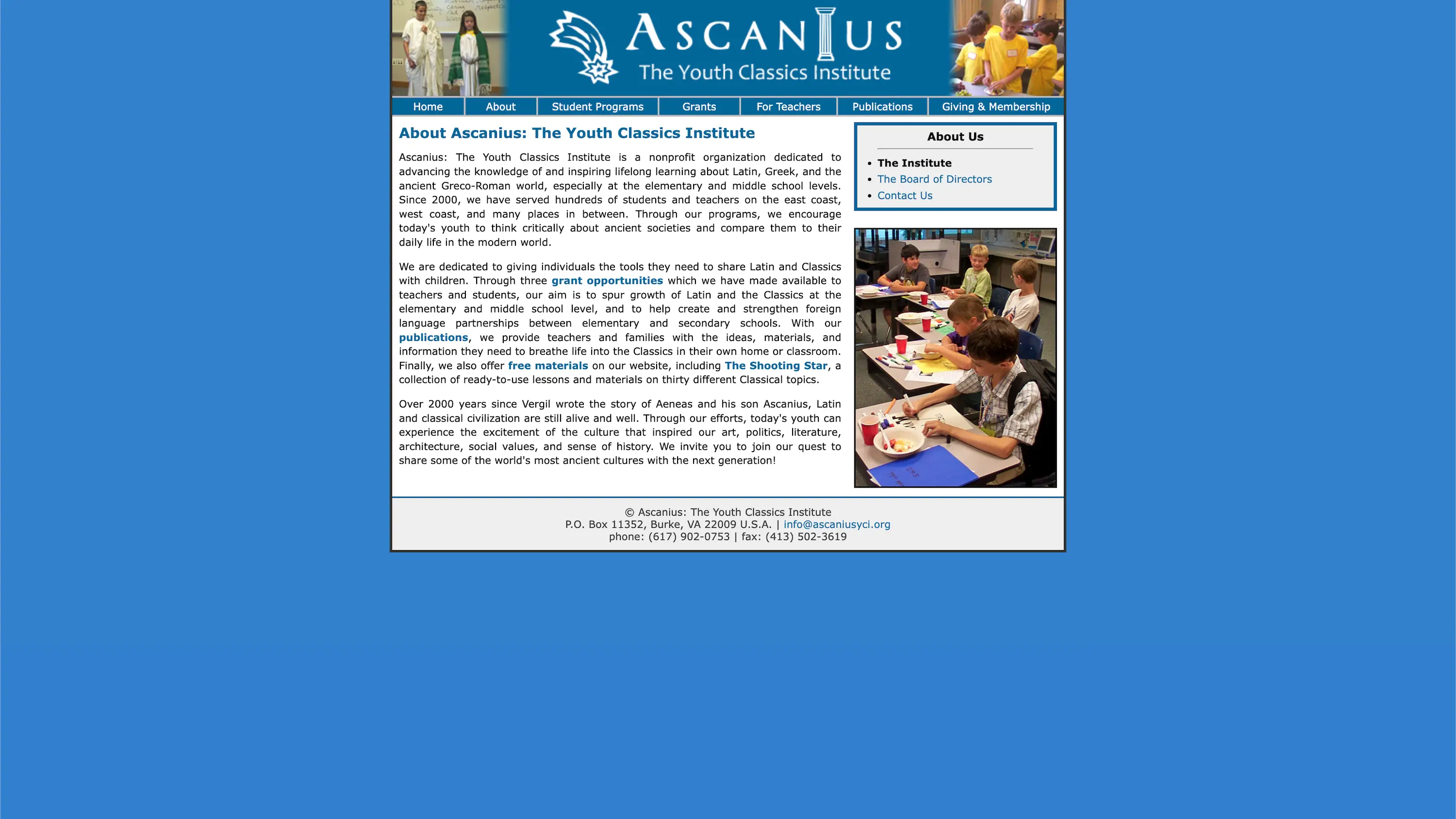
The original Ascanius website had accumulated nearly 70 pages during more than two decades of educational work. It contained an enormous amount of valuable material, but its aging HTML structure had become difficult to navigate, update, and maintain especially with the Board's busy schedules.
The project therefore involved much more than changing colors or creating a new homepage. Nearly 70 pages of content had to be evaluated, updated, organized, migrated, reformatted, and rebuilt for a modern content-management system.
Ascanius also serves several distinct audiences. A Latin teacher may arrive looking for a classroom activity. A grant applicant needs funding details, eligibility requirements, and an application. A donor wants to understand how contributions support the organization's mission. A student or parent might be searching for an educational video, while a longtime member of the Classics community may be looking for a publication or historical program.
Each visitor needed a clear path through a large and varied website.
The redesign also needed to preserve historically important materials while making the site feel current. Replacing the old website could not mean erasing the programs, publications, photographs, and teaching resources Ascanius had created over its first 25 years.
Finally, the organization needed a website its own team could manage. Routine updates should not require editing HTML or relying on an outside developer every time a grant deadline, event, photograph, publication, or board member changed.
Planning a Nearly 70-Page Website
The project began with information architecture rather than visual design.
Content from across the original site was reviewed and grouped into a more deliberate website structure. Related pages were brought together, important programs received clearer landing pages, and the main navigation was organized around the actions visitors were most likely to take.
The new structure centers the website around Ascanius' mission, grants, teacher resources, events, publications, history, and giving opportunities. Specialized content remains available beneath those main sections, including individual grant programs, The Shooting Star, eTogaTrek, downloadable lesson materials, organizational history, board information, event archives, and individual publication pages.
This structure gives the website a clearer hierarchy while preserving the depth of the original site. Visitors can learn about Ascanius and then move naturally toward a meaningful next step, whether that means applying for a grant, watching an educational video, downloading an activity, purchasing a publication, joining the email list, or making a donation.
For a redesign of this size, consistency was especially important. Reusable page layouts and visual patterns were developed so that nearly 70 pages could feel like parts of one website rather than a collection of unrelated materials.
A Modern Design That Still Feels Like Ascanius
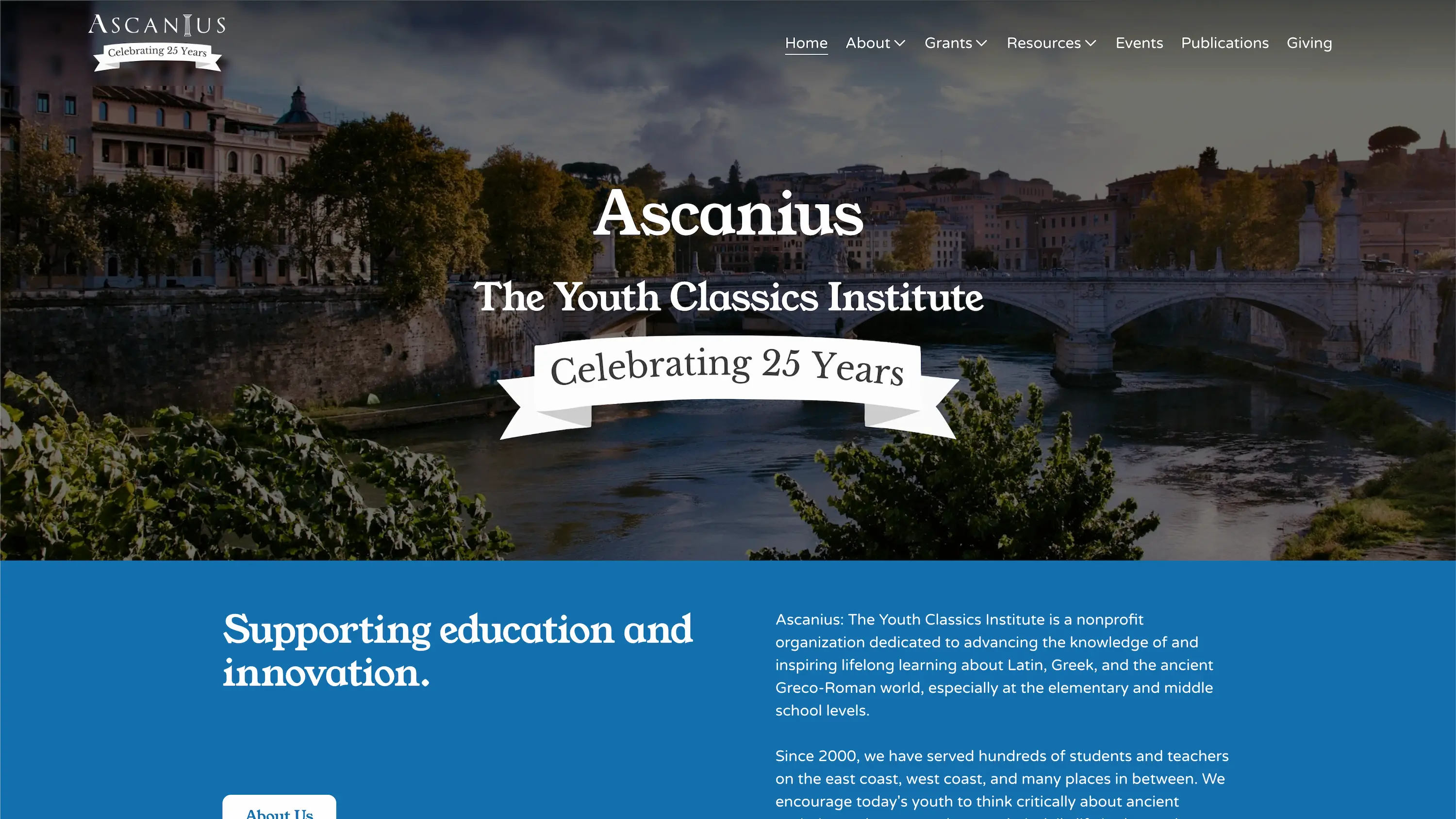
The visual redesign needed to make Ascanius feel current without making the organization feel corporate or disconnected from its educational roots.
The new design is clean, colorful, and welcoming while also tipping the hat to the signature design elements that had characterized it over the years. Historical photographs, classroom images, grant recipients, publications, and event materials help tell the organization's story throughout the site.
The finished design is professional enough for donors, partners, and grant applicants while remaining approachable for teachers, students, and families. It feels academic without becoming overly formal and modern without abandoning the organization's history.
The redesigned homepage introduces Ascanius' mission immediately and gives visitors prominent paths to its teacher resources, grants, events, publications, donation opportunities, and current announcements. It also provides space to feature grant recipients and demonstrate how the organization's support translates into real educational programs.
Rebuilding eTogaTrek as an Online Educational Series
An important part of the migration was preserving and rebuilding eTogaTrek, Ascanius' online video series for elementary- and middle-school students.
The series invites students to explore life in ancient Rome through five episodes covering Roman families and bullas, Roman clothing, architecture, mosaics, and games. Instead of treating eTogaTrek as a single archived page, the redesigned site gives the series a central landing page and a dedicated page for each episode.
The episode pages incorporate embedded YouTube videos alongside supporting educational content. Students and teachers can find supply lists, historical images, reflection questions, activity instructions, credits, and downloadable materials without leaving the lesson page.
This part of the website redesign demonstrates the importance of migrating content thoughtfully. The goal was not merely to move old videos onto a new platform. It was to rebuild eTogaTrek as a usable online learning experience that teachers, students, and families could continue to access now and into the future.
Making Grants Easier to Understand
Grant programs are central to Ascanius' mission, so the website redesign gave them a more prominent and organized home.
A central grants page now introduces the Classical Promise Grant, the Rudolph Masciantonio “Classics for All” Grant, and the Ascanius Grant for Professional Development. Visitors can compare the programs before moving into pages with more detailed information about funding, eligibility, deadlines, and applications.
Grant deadlines and opportunities also appear in other relevant areas of the website, including the homepage. This helps prevent important information from becoming isolated inside a single section.
The redesigned homepage also highlights recent grant recipients and explains what their funding accomplished. These stories show visitors how Ascanius supports teachers, students, and Classics programs in practice rather than describing its grants only in abstract terms.
Bringing Teacher Resources to the Forefront
Ascanius has created a significant library of educational materials throughout its history. A major goal of the website redesign was to make those resources easier for teachers to discover and use.
The new Teacher Resources section provides clearer access to The Shooting Star, eTogaTrek, and Ascanius' collection of free lesson materials and classroom activities. These resources are now presented as an important part of Ascanius' ongoing mission rather than being buried within the organization's history.
Individual resource pages combine introductory information, visual navigation, downloadable files, embedded content, and links to related materials. The result is a resource library that is more approachable for new visitors while remaining useful to returning teachers who already know what they need. Moreover, carefully planned redirects made sure that old bookmarks would still navigate users to the right webpage.
Preserving 25 Years of Organizational History
Modernizing a long-running nonprofit website requires careful judgment about what should change and what must be preserved.
Ascanius had decades of programs, publications, lesson materials, event records, photographs, and organizational history that still carried educational and historical value. The website redesign created dedicated space for that story, including clearer access to information about the organization's beginnings, leadership, programs, and long-term mission.
Older teaching resources were reorganized into formats that are easier to browse. Past conference workshops and events were retained as evidence of Ascanius' involvement in the Classics community. Historical publications were preserved alongside newer offerings.
This allowed the nearly 70-page website to become more coherent without making Ascanius look like a newly created organization. The finished site communicates both sides of its identity: a nonprofit with a substantial history and an organization that remains actively involved in Classics education today.
Organizing Publications and Online Sales
Ascanius offers both free and paid educational publications. The redesigned publications section brings these resources together while connecting each purchase to the organization's educational mission.
Visitors can download free anniversary publications, explore digital materials, or learn about printed resources. Product pages provide room for publication descriptions, author information, available formats, pricing, sample downloads, classroom uses, and purchasing details.
The site also explains that proceeds from publication sales support Ascanius' grants and educational programs. This helps visitors understand that purchasing a resource also contributes to the organization's wider work.
Supporting Events, Outreach, and Future Updates
Ascanius regularly participates in conferences, workshops, and community events. The redesigned Events section accommodates both upcoming appearances and highlights from past programs.
Current events can be promoted with dates, locations, images, descriptions, and downloadable materials. Past events can remain available as evidence of Ascanius' work and as a home for related workshop resources.
Email signup opportunities are also incorporated throughout the website, giving Ascanius a way to maintain a longer-term connection with teachers and supporters.
Because the new website uses Squarespace, the Ascanius team can update deadlines, announce events, add grant recipients, revise program information, upload resources, manage publications, change photographs, and publish new content without editing HTML.
A Collaborative Website Redesign Process
The website was developed through an ongoing review and revision process with the Ascanius team.
Major page types and sections were shared for feedback as the project progressed. This allowed the organization to review the visual direction, confirm the new content structure, and refine how individual programs were presented before the nearly 70-page site was finalized.
The project included the homepage, About section, organizational history, board information, grant hub, individual grant pages, teacher resources, eTogaTrek series, lesson-material collections, events, publications, product pages, donation information, contact content, and numerous supporting and historical pages.
Before launch, the website was reviewed for consistent layouts, functional navigation, responsive behavior, working links, and a coherent visitor experience. The completed Squarespace website was then launched and transferred to the client's account.
The Result
The completed nonprofit website redesign gives Ascanius a cleaner, more professional, and significantly more manageable online presence for its 25th anniversary and beyond.
Nearly 70 pages of organizational information, grant opportunities, educational videos, teaching resources, downloads, publications, events, and historical content now exist within one consistent website.
Teachers can more easily discover classroom materials. Grant applicants can identify the correct funding opportunity and find the information needed to apply. Donors can understand how their support advances Classics education. Students and families can use resources such as eTogaTrek directly from the website. Ascanius staff can make routine updates without editing the underlying code.
Most importantly, the redesign did not discard the organization's past. It created a clearer framework for presenting more than 25 years of educational work while giving Ascanius room to continue growing.
The result is a website that feels established but not dated, substantial but not overwhelming, and professional without losing the enthusiasm for Classics education at the heart of the organization.